Skip to Content

About the Quantum Governance Studio

The Qword demo treats quantum circuits as a way of thinking about shared decisions, not as a black‑box “magic” technology. This page explains the two small circuits that drive the live governance field and the system status view.

From public votes to a quantum field

Visitors and online participants vote on where they feel the governance field should move: towards the Parthenon marbles, towards the Benin bronzes, or towards new reparative configurations. The stack aggregates these votes into a set of numeric field weights. Those weights are then encoded in a tiny two‑qubit program, so that quantum operations and measurement noise become part of the reflection on the crowd’s decisions.

Circuit 1: Quantum vote weights
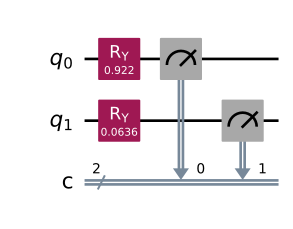
Quantum vote weights as a two‑qubit circuit
Quantum vote weights as a two‑qubit circuit. Each horizontal line is a qubit wire: q0 and q1 start in the neutral state |0⟩. The dark red RY boxes are rotation gates: they tilt each qubit away from |0⟩ by an angle that encodes the current vote weights. The numbers (for example 0.922 and 0.0636) come directly from the live Parthenon / Benin field and are updated as new votes arrive. The grey boxes are measurements that collapse the qubits back to classical bits on the “c” register. Reading these bits many times gives a distribution of outcomes, which we interpret as a quantum‑influenced reflection of the public’s preferences.

Circuit 2: Minimal entangling circuit
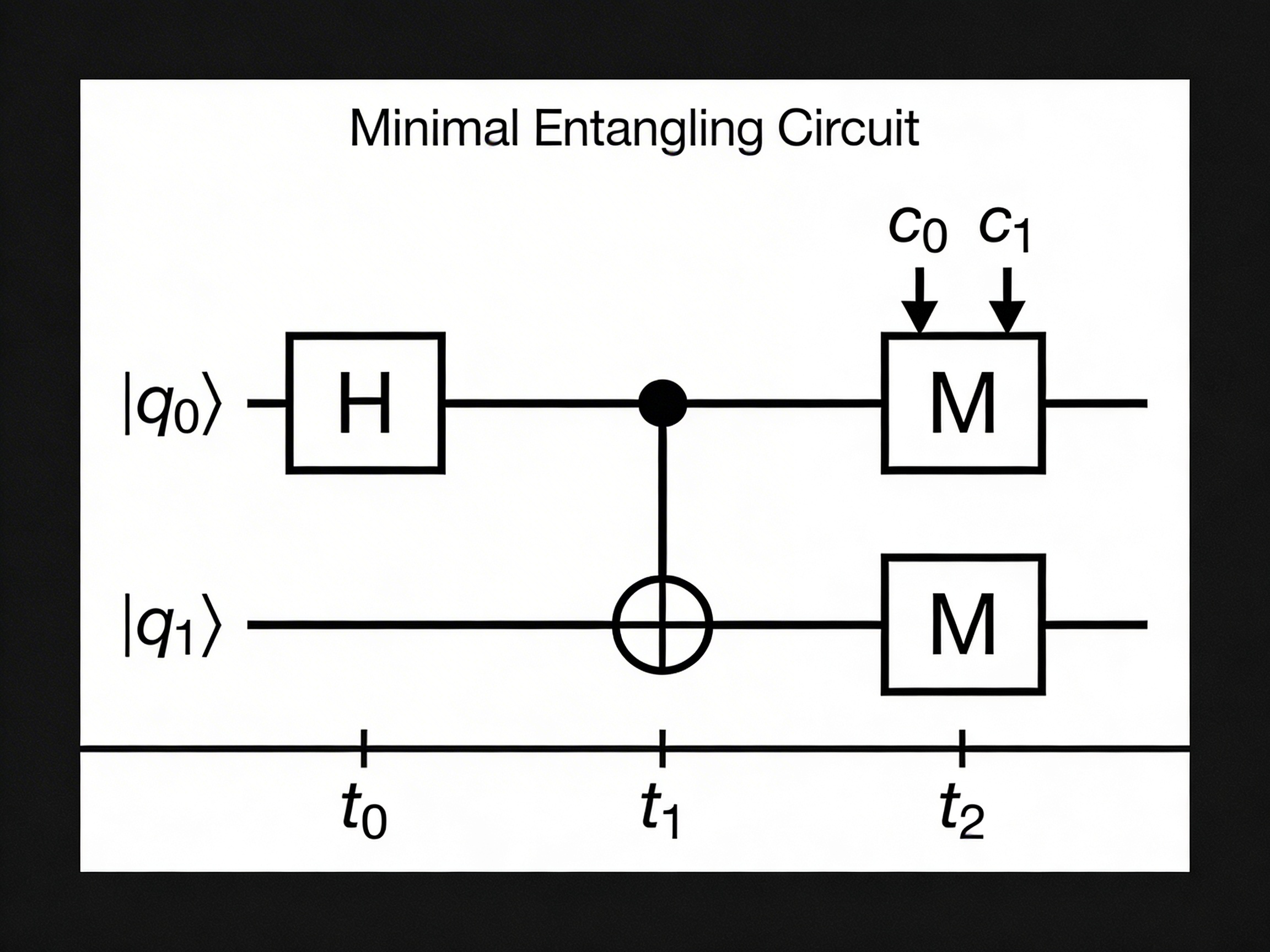
Minimal entangling circuit for the governance field
Minimal entangling circuit for the governance field. This reference circuit shows the simplest way the stack can create entanglement between two qubits. The upper and lower lines are qubits |q0⟩ and |q1⟩, evolving from left to right in time. At t0, a Hadamard gate on |q0⟩ puts it into a superposition: it is partly |0⟩ and partly |1⟩. At t1, a controlled‑NOT gate uses the state of |q0⟩ to flip |q1⟩, creating an entangled pair whose outcomes are now correlated. At t2, both qubits are measured and written to classical bits c0 and c1. In the Qword demo this circuit is a conceptual model for how individual choices can become bound together in a shared governance field.

Both circuits run entirely on local compute at demos.uquantum.uk, with no external AI services or cloud inference. They are meant as transparent, inspectable components of the governance stack rather than opaque optimisation layers.

The Quantum Governance Studio runs as a local stack on demos.uquantum.uk, with regular updates from the voting field and a nightly local AI reflection. For operators, a live system status view exposes the current pipeline, AI runs, and activity log.